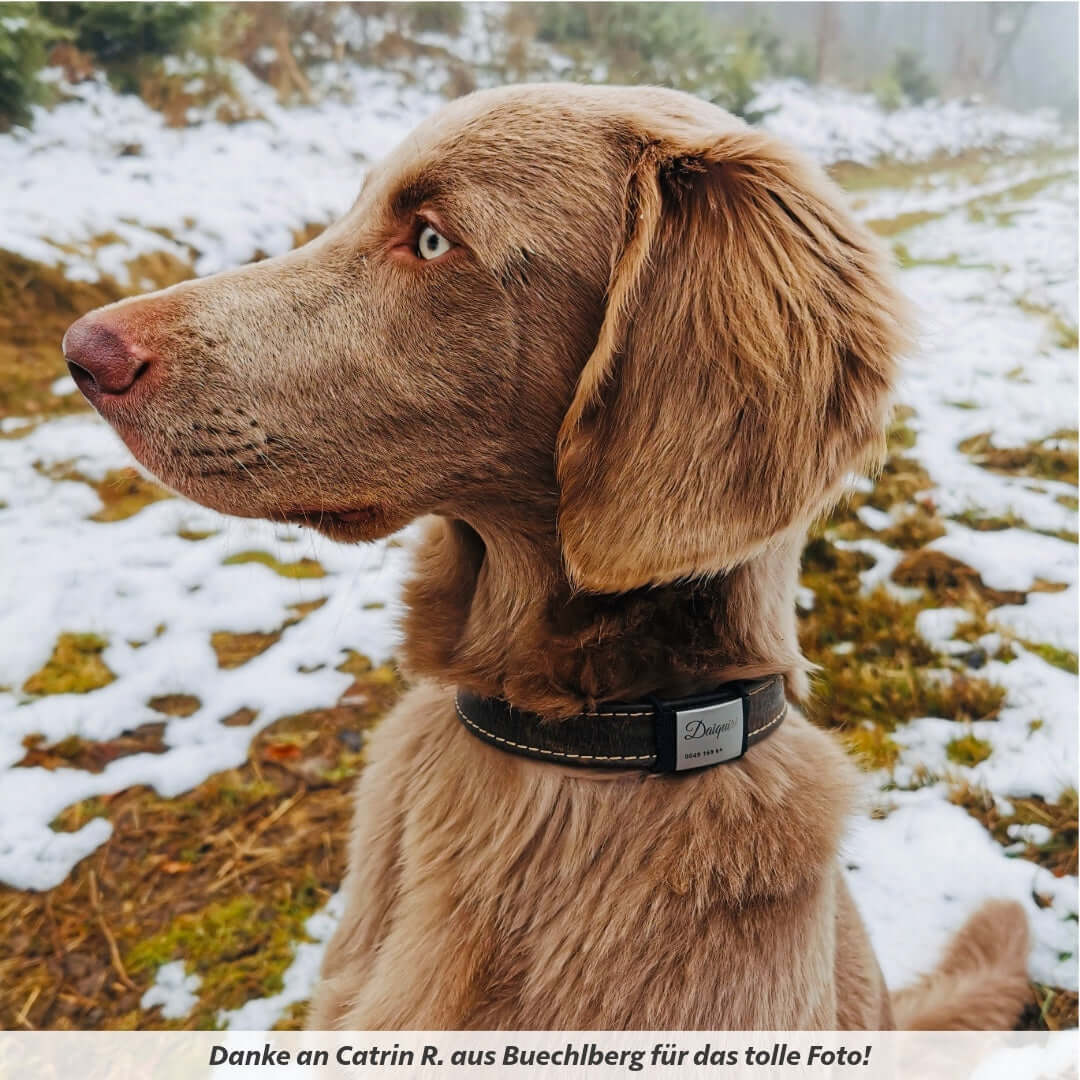
For us, New Year's Eve means fireworks, celebrations and a good start to the new year. For many dogs, however, it is the most stressful night of the year.
Loud bangs, bright flashes of light and unfamiliar smells can panic even the most relaxed dogs. And sometimes a single bang is enough to make a dog run away.
With the right preparation, you can make the turn of the year much easier for your dog. And you can make sure that he quickly finds his way home if he runs away despite all precautions.
The figures show how great the risk is: According to TASSO, 428 dogs were reported missing on New Year's Eve 2024/25 alone – on a normal day, the average is 79 (Source).
1. New Year's Eve walks: Better earlier than later
The first firecrackers often go off in the afternoon. That is why you should plan your New Year's Eve walks as early as possible.
Use the morning for a long walk. Your dog can exercise, sniff around and burn off energy before things get hectic outside.
What to keep in mind:
- A long walk in the morning: Go for a walk as early as possible in a quiet environment.
- Only go out briefly in the evening: Keep the last walk to the bare essentials and choose a sheltered location.
- No experiments: Stick to familiar routes. New environments can cause additional stress.
- No off-leash walks: Even if your dog normally listens reliably, he should be on a leash all around New Year's Eve.
Tip: Don't just plan your walks accordingly on December 31st. Firecrackers are unfortunately also set off in the days before and after.
2. Double security is better: Leash and harness
A loud bang, a brief fright – and suddenly your dog tries to wriggle out of its harness.
Especially with anxious dogs, this can happen faster than you can react.
Check beforehand whether the harness, collar, carabiner and leash fit properly and show no signs of damage.
The safest option is the leash attached to a well-fitting harness plus a second safety measure on the collar, for example with a double leash or a connecting piece.
Important: Never attach the leash exclusively to a loose-fitting collar. A panicking dog can sometimes pull itself out of it backwards.
And one more thing: Even your own garden is no safe place for unsupervised off-leash walks on New Year's Eve. Some dogs suddenly overcome fences out of fear that were never a problem before.
3. A safe retreat for your dog
While people are celebrating outside, your dog needs one thing above all: a place where he feels safe.
Therefore, prepare a cozy retreat for him well in advance.
This can be his favorite bed, a familiar corner in the living room or a quiet room where as little noise and light as possible can enter.
How to make it easier for your dog:
- Close windows, roller shutters and curtains to reduce noise and flashes of light.
- Turn on music or the television at a pleasant volume to slightly mask outside noises.
- Provide his bed, his favorite blanket and fresh water.
- Offer him something to chew on or a lick mat, provided he is receptive to it.
- Stay as close to him as possible if he seeks your company.
Do not force your dog to leave his retreat. Some dogs want to hide, others seek physical contact. Both are completely fine.
By the way: You can of course comfort your dog if he is afraid. Calm attention does not automatically increase his anxiety.
If your dog regularly shows severe panic on New Year's Eve, speak to your veterinarian in good time. There are ways to help him specifically. However, you should never administer medication on your own!
4. What needs to be on the collar so that your dog can find his way home?
Even with the best preparation, a run-away cannot be completely ruled out.
That is why you should ask yourself an important question before New Year's Eve:
Can someone who finds my dog reach me immediately?
A microchip is important. However, a finder cannot simply read the stored chip number with a smartphone. For that, they need a special reader, for example at a veterinarian or animal shelter.
A dog tag with your contact details makes it much easier.
Our silent dog tags are laser-engraved with your phone number and lie flat on the collar – nothing jingles, which additionally stresses a noise-sensitive dog.
Why many tags rattle and what helps against it, you can read in our post Dog tag rattles? What helps?
This information belongs on the dog tag:
1. Your phone number
This is the most important information. Whoever finds your dog should be able to call you without any detours.
2. A second phone number
Optionally, you can provide the number of another trusted person. If you are not reachable, there is an alternative.
3. Your dog's name
The name can help to call your dog calmly. However, the phone number is crucial for the return of the dog.
4. Further information
Medical notes or other information can also be helpful.
Your full home address, on the other hand, is not strictly necessary. A clearly legible phone number is often enough to make contact quickly.
5. Check TASSO registration: Is your dog really registered?
Many dogs already have a microchip. What some dog owners do not know, however:
A microchip alone does not bring your dog home.
The chip contains an individual identification number. For this to be assigned to your dog and your contact details, it must be registered in a pet registry.
In Germany, for example, TASSO e. V. offers free registration.
Therefore, check well in advance of New Year's Eve:
- Is your dog registered at all?
- Is the stored phone number still up to date?
- Is your address correct?
- Is all the information about your dog correct?
Especially after a move or a change of phone number, the update is quickly forgotten.
Our tip: Combine the registration with a dog tag. Both fulfill different tasks and complement each other sensibly.
The microchip enables unique identification. The dog tag allows a finder to call you directly.
6. Dog runs away on New Year's Eve – what now?
Despite all precautions, your dog has run away?
Now, above all, it counts to act calmly and systematically.
Step 1: Stay calm
Try not to run blindly after your dog.
A panicking dog can flee even further through frantic pursuit. If you see him, approach as calmly as possible and avoid cornering him.
Step 2: Inform TASSO
Report your dog as missing to TASSO as quickly as possible, provided he is registered there.
The organization assists in the search and can help to assign your dog in the event of a later found report.
Step 3: Contact the police and animal shelters
Inform the local police as well as animal shelters and responsible found-animal stations.
Provide as accurate a description of your dog as possible and state when and where he ran away.
Step 4: Spread the search report
Use local dog groups, neighborhood networks and social media.
A good search report contains:
- A current photo of your dog
- The location and time of the disappearance
- Striking features
- A reachable phone number
- The indication of whether your dog is anxious and should not be pursued
Step 5: Collect sightings
Please ask people who discover your dog to report the location and time of the sighting.
Especially with panicking dogs, it is often better to document sightings than to run after them uncoordinatedly.
If your dog remains missing for a long time or is particularly anxious, an experienced animal search service can help.
Important: Do not put yourself in danger during the search. Especially on New Year's Eve, road traffic, fireworks and unobservable situations are additional risks.
7. Your New Year's Eve checklist for a safe turn of the year
Before the first rockets take off, you should have completed these points:
- Plan walks early
- Check safety harness and collar
- Keep your dog on a leash outside consistently
- Secure windows, doors and garden gates
- Prepare a quiet retreat
- Phone number on the dog tag checked
- TASSO registration and contact details checked
- Current photo of your dog ready
- Seek veterinary advice in good time in case of severe noise anxiety
New Year's Eve does not have to become the greatest burden of the year for your dog. With a little preparation, a safe retreat and the right security, you can significantly reduce many risks.
And what if something does happen?
Then it is crucial that your dog can be identified quickly and someone can reach you easily.
A registered microchip and a clearly legible dog tag therefore go together.
This way, you are prepared not only for New Year's Eve, but for every single day of the year.